
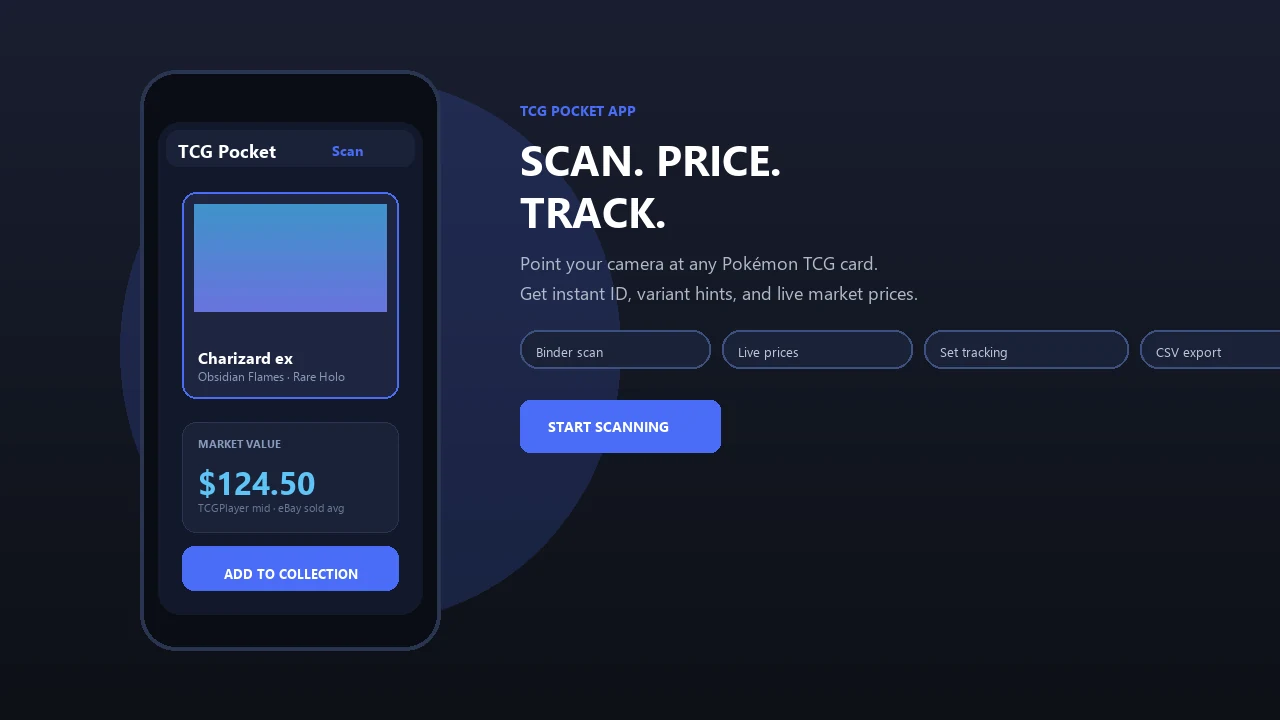
Scan physical Pokémon cards, confirm each match, review current market estimates, and calculate the total value of your collection with Pokemon Card Scanner on iOS and the web.
Pokemon Card Scanner runs on iOS and web. Get pokemon card collection value calculator app when you are ready to scan.
What Is a Pokemon Card Collection Value Calculator?
A Pokemon card collection value calculator estimates what a group of physical trading cards may be worth. Instead of checking every card manually and adding the prices in a spreadsheet, you can use Pokemon Card Scanner to identify cards, save them to your collection, and view a combined estimated value.
The calculation depends on matching each card to the correct printing. A card's name alone is not enough because the set, card number, finish, edition, language, and condition can affect its market price. Once those details are confirmed, a collection value tracker can combine the individual estimates into a running total.
This total is best treated as a current market estimate rather than a guaranteed sale price. Actual proceeds depend on card condition, buyer demand, selling fees, shipping costs, and the marketplace used.
Scan Cards and Calculate Your Collection Total
Camera-based scanning makes valuation faster for binders, storage boxes, recent pulls, and newly purchased lots. Use Pokemon Card Scanner on iOS to capture a physical card, review the suggested match, and add the correct entry to your collection. You can also manage and review your cards through the web.
- Place the card on a plain, well-lit surface.
- Scan the front without covering the artwork, name, or card number.
- Confirm the card name, expansion, collector number, rarity, and variant.
- Select the relevant condition when that information is available.
- Add the card to your collection and enter the correct quantity.
- Repeat the process to build a combined collection estimate.
Always review uncertain matches before saving them. A similar illustration can appear in several sets or products, and a wrong printing can significantly change the calculated total.
Match the Set, Variant, and Edition
Accurate identification is the foundation of any Pokémon card value checker. Two cards with the same Pokémon and artwork may have different collector numbers, set symbols, foil treatments, stamps, or edition markings. These details help separate inexpensive printings from scarcer versions.
- Check the set symbol and collector number near the bottom of the card.
- Distinguish standard, holo, reverse holo, promotional, and stamped versions.
- For older cards, verify 1st Edition and unlimited printings.
- Confirm the card's language and regional version.
- Record duplicate quantities instead of scanning one copy as the entire group.
Reviewing these details prevents a premium variant from being priced as a standard copy. It also reduces the chance that an ordinary reprint inflates the total by being matched to a rarer release.
How Market Prices Shape the Estimate
A useful collection calculator should reflect recent market behavior rather than rely on one permanent price. Collectors commonly compare TCGplayer prices, CardMarket prices, active listings, and eBay sold prices. Sold comps can be particularly helpful because they show completed transactions instead of seller asking prices.
Named tools in the card-valuation market illustrate this approach. PokeScope says it uses TCGplayer and CardMarket pricing, while Guardian TCG describes calculations based on TCGplayer, eBay, and CardMarket data. Card Catcher also presents live values and collection tracking as connected parts of the valuation process.
Different sources can show different numbers because they cover separate regions, sellers, conditions, and transaction periods. For that reason, value may be shown as a market estimate or low, mid, and high range. Compare recent sold examples when evaluating an especially rare or expensive card.
Account for Condition and Graded Values
Condition can materially change what a buyer will pay. Edge wear, whitening, scratches, creases, dents, surface marks, and centering all influence value. A clean binder card and a heavily played copy should not receive the same practical estimate, even when both share the same set and collector number.
- Inspect the front and back under direct, neutral lighting.
- Look closely at corners, edges, foil surfaces, and scratches.
- Use conservative condition choices when damage is difficult to classify.
- Keep raw-card estimates separate from professionally graded card prices.
A scanner is not a professional grading service. Graded prices can provide useful comparison points, but a card must be authenticated and assigned a grade by the named grading company before it should be valued as that grade. Current value and price trends can help you decide whether grading costs merit further research.
Track Value as Your Collection Changes
Your collection total can change when market prices move, when cards are added or removed, or when identification and condition details are corrected. A saved collection provides a clearer view than a one-time lookup because it keeps individual cards and quantities connected to the overall estimate.
Use the total to organize collecting decisions, compare parts of a binder, document recent purchases, or identify cards that deserve closer condition review. Value My Card describes portfolio features that include total collection value and profit or loss, while DittoDex connects scanning with live TCGplayer checks. These examples reflect the broader shift from single-card searches to ongoing collection management.
Recheck important cards periodically and before selling, trading, insuring, or submitting them for grading. Market estimates are snapshots, so an older saved price may not represent current demand.