
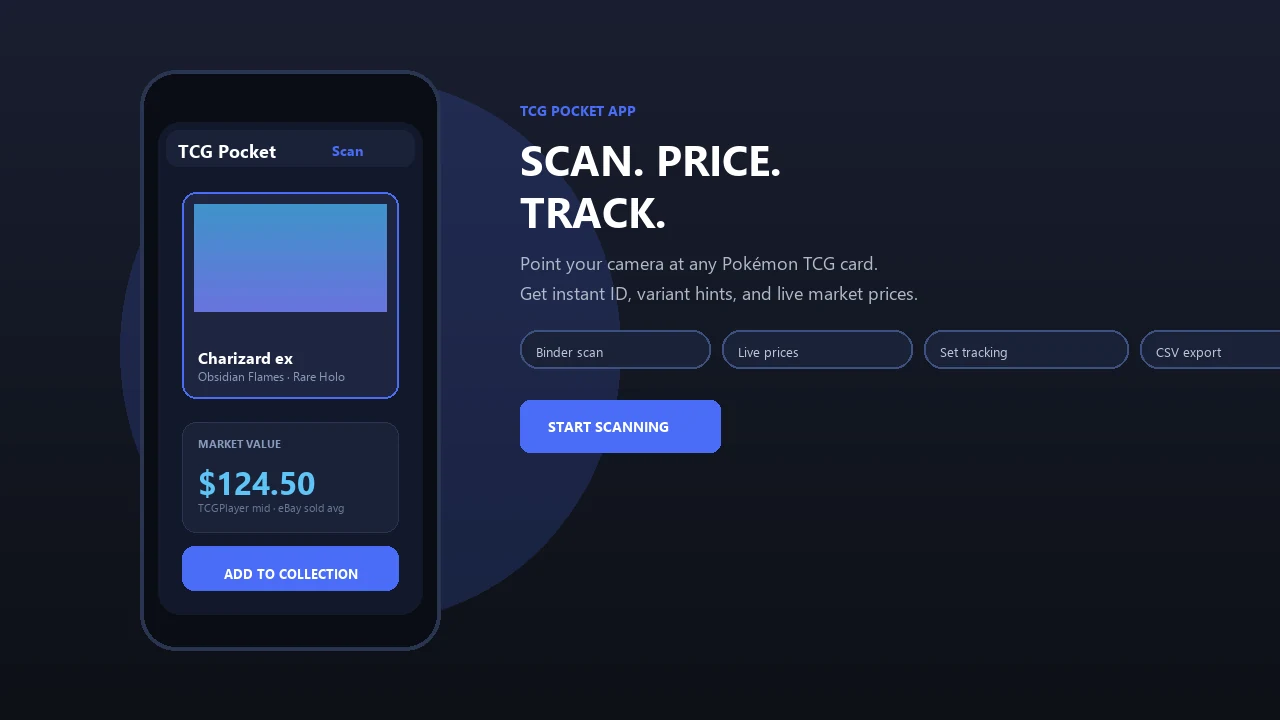
Scan a Pokémon card, compare its raw value with estimated PSA 8, PSA 9, and PSA 10 outcomes, and judge whether the possible premium may justify grading costs.
Pokemon Card Scanner runs on iOS and web. Get psa grade value ladder when you are ready to scan.
What Is a PSA Grade Value Ladder?
A PSA grade value ladder compares the market price of an ungraded, or raw, Pokémon card with prices for copies graded PSA 8, PSA 9, and PSA 10. Pokemon Card Scanner organizes these values into a practical comparison so collectors can see how much value each grade could add before deciding whether to submit a card.
The ladder matters because a high raw price does not automatically make grading profitable. The difference between raw and graded prices must be large enough to cover grading, shipping, insurance, possible seller fees, and the risk of receiving a lower grade than expected.
- Raw value establishes the starting market price.
- PSA 8 shows a conservative graded outcome for a clean card with visible flaws.
- PSA 9 represents a strong Mint result.
- PSA 10 represents the Gem Mint benchmark and usually carries the largest collector premium.
Each ladder is specific to the card, set, printing, language, and current market. A multiplier that fits one card should not be applied automatically to another.
How PSA 8, PSA 9, and PSA 10 Values Compare
PSA uses a 10-point grading scale for trading cards. PSA identifies an 8 as Near Mint-Mint, a 9 as Mint, and a 10 as Gem Mint. Small condition differences near the top of this scale can produce large price differences, especially when buyers compete for scarce high-grade copies.
PSA 10 usually occupies the top of the value ladder. PSA 9 can still provide a meaningful increase over raw value, while PSA 8 is often the lowest premium grade actively considered by many collectors. That pattern is common, but it is not guaranteed.
PokeTrace has published broad guidance suggesting that PSA 10 values can reach roughly 10 to 100 times raw, PSA 9 values about 3 to 10 times raw, and PSA 8 values about 1.5 to 3 times raw. These ranges are market heuristics, not fixed valuation rules. Modern population levels, vintage scarcity, artwork demand, set popularity, and recent sales can move an individual card well outside them.
Compare Raw Prices With Sold Market Data
A useful value ladder starts with comparable sales rather than optimistic asking prices. Completed eBay sales can show what buyers recently paid for the same card and grade. When reviewing those sales, match the set number, variation, language, edition, and certification grade as closely as possible.
TCGplayer market pricing is a common reference for raw Pokémon cards in the United States. Cardmarket serves a similar role for many European collectors. Regional demand, currency, card language, taxes, and shipping can create different ladders for the same card, so comparisons should reflect the market where the card is likely to be sold.
- Use raw listings that reflect a condition similar to your copy.
- Prioritize recent sold transactions for graded cards.
- Separate English, Japanese, and other language printings.
- Do not combine unlimited, first edition, reverse holo, stamped, or promotional variants.
- Treat a single unusually high sale as an outlier until other sales support it.
PSA’s price guide can provide another grading reference, but recent marketplace transactions add context about current buyer behavior.
Estimate Whether Grading Is Worth the Cost
The headline PSA 10 price should not be the only number in a grading decision. A realistic calculation uses several possible outcomes, including PSA 8 or PSA 9, because even attractive cards can have centering, surface, edge, or corner issues that prevent a Gem Mint grade.
- Identify the exact card and establish a realistic raw value.
- Review recent prices for PSA 8, PSA 9, and PSA 10 copies.
- Inspect centering, corners, edges, surface, print lines, scratches, dents, and whitening.
- Estimate the most likely grade rather than assuming PSA 10.
- Subtract grading, shipping, insurance, and expected selling fees from the graded value.
- Compare the net result with what the card could sell for raw.
PSA submission pricing is tiered by service level and declared value, so costs can vary by card and submission method. Turnaround time and price movement also matter. A premium visible today may narrow before the graded card returns, while demand for a scarce card may increase. The ladder supports a better estimate, not a guaranteed profit.
Why the Grade Gap Varies by Pokémon Card
Two cards with similar raw prices can have very different PSA ladders. A modern chase card may be widely available raw but difficult to obtain with ideal centering. A vintage holo may have a low PSA 10 population because surviving copies commonly show scratches, silvering, edge wear, or print defects.
Collector demand also changes the size of each step. Popular Pokémon, notable artwork, first appearances, competitive relevance, and landmark sets may attract stronger interest. Population data can add context, but population alone does not determine value. A scarce grade still needs enough active buyers to support its premium.
- Modern cards may have many PSA 9 and PSA 10 copies entering the market.
- Vintage cards may show a steep jump from PSA 9 to PSA 10 because Gem Mint examples are scarce.
- Some PSA 8 copies sell close to clean raw cards, leaving little room after expenses.
- Low-demand cards can have irregular ladders when few graded sales are available.
- New releases may experience rapid price changes before the market settles.
Review the card’s own sales history instead of relying on a universal grade multiplier.
Build a Grading Shortlist With Pokemon Card Scanner
Pokemon Card Scanner helps turn a collection review into a grading shortlist. Scan a physical Pokémon card, confirm the identified set and variant, then compare its raw price with available PSA 8, PSA 9, and PSA 10 market outcomes. The ladder makes it easier to spot cards where the potential grade premium is large enough to deserve closer condition inspection.
Start by scanning cards that appear clean, valuable, or difficult to replace. Remove cards with creases, dents, heavy whitening, deep scratches, or obvious centering problems unless lower-grade demand remains strong. For the remaining cards, compare conservative and optimistic outcomes rather than sorting only by the PSA 10 price.
The scanner is available on iOS and the web, letting collectors research individual cards or review a larger group before preparing a submission. It does not assign an official PSA grade. Final grades are determined by PSA after physical authentication and inspection, so use the ladder as a pricing and decision tool rather than a grading promise.