
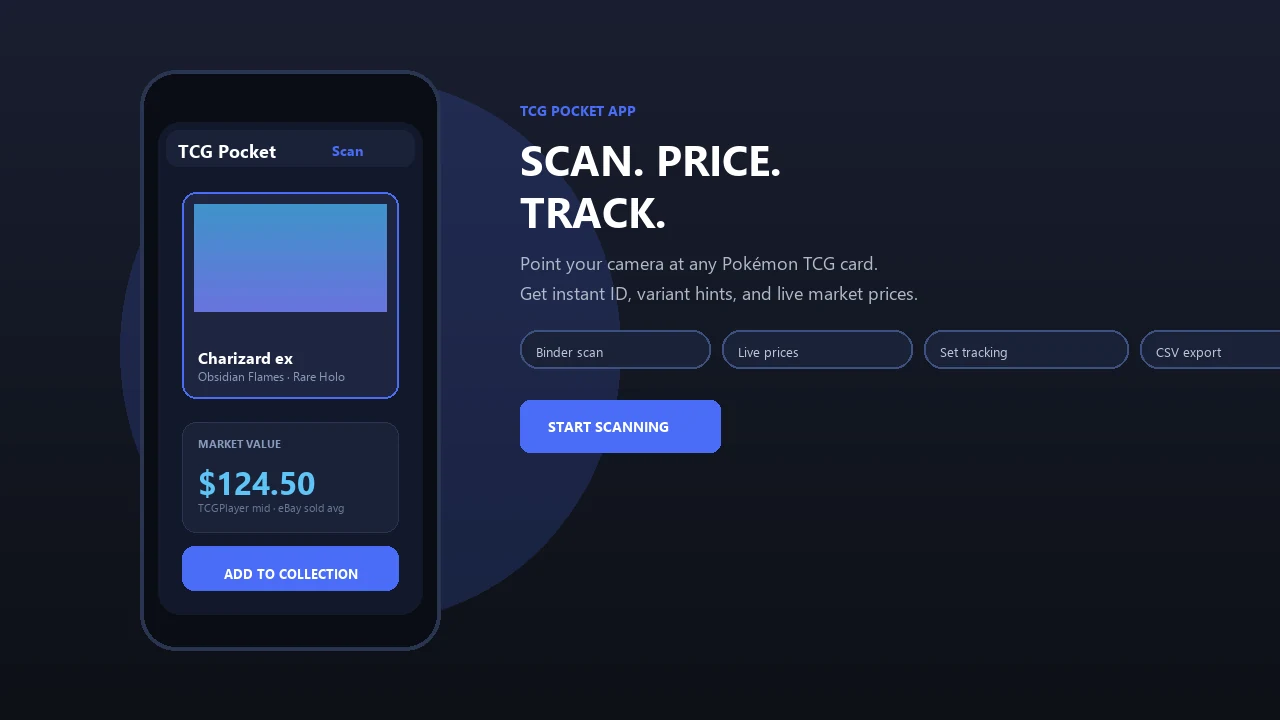
Turn a collection into a trackable portfolio. Scan cards, record what you paid, follow estimated market values, and review gains, losses, ROI, and top movers from iOS or the web.
Pokemon Card Scanner runs on iOS and web. Get pokemon card portfolio tracker when you are ready to scan.
What Is a Pokemon Card Portfolio Tracker?
A Pokemon card portfolio tracker organizes your physical trading cards and connects each entry with useful financial details. Instead of keeping purchase prices in spreadsheets or checking every card manually, you can build one collection view that shows estimated value, cost basis, and performance over time.
Pokemon Card Scanner helps you identify cards with your iPhone camera, add them to a portfolio, and review the collection on iOS or the web. This investor-focused approach is useful for raw singles, graded slabs, long-term holdings, and cards you may eventually sell or trade.
Portfolio values are estimates rather than guaranteed sale prices. Condition, grading company, certification grade, language, print variation, and marketplace demand can all affect what a buyer will pay.
Scan Cards and Build Your Portfolio Faster
Camera scanning reduces the time spent searching for set names, card numbers, and variations. Point your iPhone at a physical Pokemon card, review the suggested match, and confirm the correct printing before adding it to your collection. You can then enter quantity, condition, purchase date, and acquisition cost.
Accurate identification matters because cards with similar artwork may come from different sets, products, or reprints. A small variation can have a very different market value, so collectors should verify the set symbol, collector number, rarity, finish, and language.
- Scan raw cards before sorting them into binders or storage boxes.
- Add graded cards with the grading company and grade recorded separately.
- Group duplicate copies while preserving their individual purchase costs.
- Use the web view for broader portfolio review and the iOS scanner for quick additions.
Track Cost Basis, Profit, and ROI
Market value alone does not show whether an investment is performing well. Cost basis records the amount committed to a card, including its purchase price and any relevant buyer fees, shipping, grading, or authentication expenses. Keeping these figures with the card creates a clearer view of unrealized profit and loss.
ROI compares the estimated gain or loss with the capital invested. For example, two cards may each rise by the same dollar amount, but the lower-cost purchase could have the stronger percentage return. This makes ROI useful when comparing cards across sets, eras, and price tiers.
PokeInvesting described inventory tools that track what a collector paid, current worth, FIFO cost basis, and sales P&L in 2026. PullRate also highlighted purchase price, market value, unrealized gain, and performers ranked by ROI. These are practical reference points for evaluating a Pokemon card portfolio rather than focusing only on headline prices.
Follow Daily Value Changes and Top Movers
Daily value changes help you see which cards are moving without checking the entire collection one by one. A top-movers view can separate gainers from losers, rank holdings by percentage change, and reveal which cards contribute most to the portfolio's overall movement.
Short-term price changes should be treated as signals, not automatic instructions to buy or sell. Thin sales volume, one unusually high transaction, a new product announcement, competitive play, or renewed collector interest can temporarily affect market estimates.
TCGPriceHub noted Cardmarket-based daily, weekly, and monthly changes in 2026, while DeckTradr highlighted top movers, trending cards, and grading plays. Reviewing several time periods can provide more context than reacting to a single daily change. It can also help distinguish a sustained trend from ordinary market noise.
Compare Market Pricing References
A reliable valuation process considers recent marketplace activity rather than relying on one asking price. Pokemon collectors commonly reference TCGplayer-style market data, eBay sold listings, and Cardmarket pricing. Each source reflects a different marketplace, region, fee structure, and buyer pool, so values may not match exactly.
Card Codex reported in 2024 that its reviewed tracker used TCGplayer data for raw and graded pricing and included trending cards. TCGPriceTracker emphasized purchase cost, profit, ROI, Cardmarket pricing, and grading support in 2026. These examples show why pricing context matters when reviewing portfolio performance.
- Check sold transactions instead of unsold asking prices when possible.
- Match the exact set, variation, language, condition, and grade.
- Consider selling fees and shipping when estimating net proceeds.
- Use market values as informed estimates, not guaranteed cash values.
Evaluate Raw Cards and Grading ROI
Raw and graded cards should be tracked separately because their markets behave differently. A graded card's value depends on the grading company, assigned grade, label details, and buyer confidence. PSA, CGC, and BGS slabs may also have different demand at equivalent numeric grades.
Grading ROI starts with the expected graded value, then accounts for the raw card's cost, grading fee, shipping, insurance, and the risk of receiving a lower grade than expected. Pokenomics described grading ROI alongside CAGR, gain and loss, and market trend analysis in 2026. PokeVest also listed camera scanning, daily updates, watchlists, and raw or graded support for PSA, BGS, CGC, and SGC.
Track grading expenses as part of cost basis rather than treating the slab's market price as pure profit. This produces a more realistic estimate of the return if the card is sold.